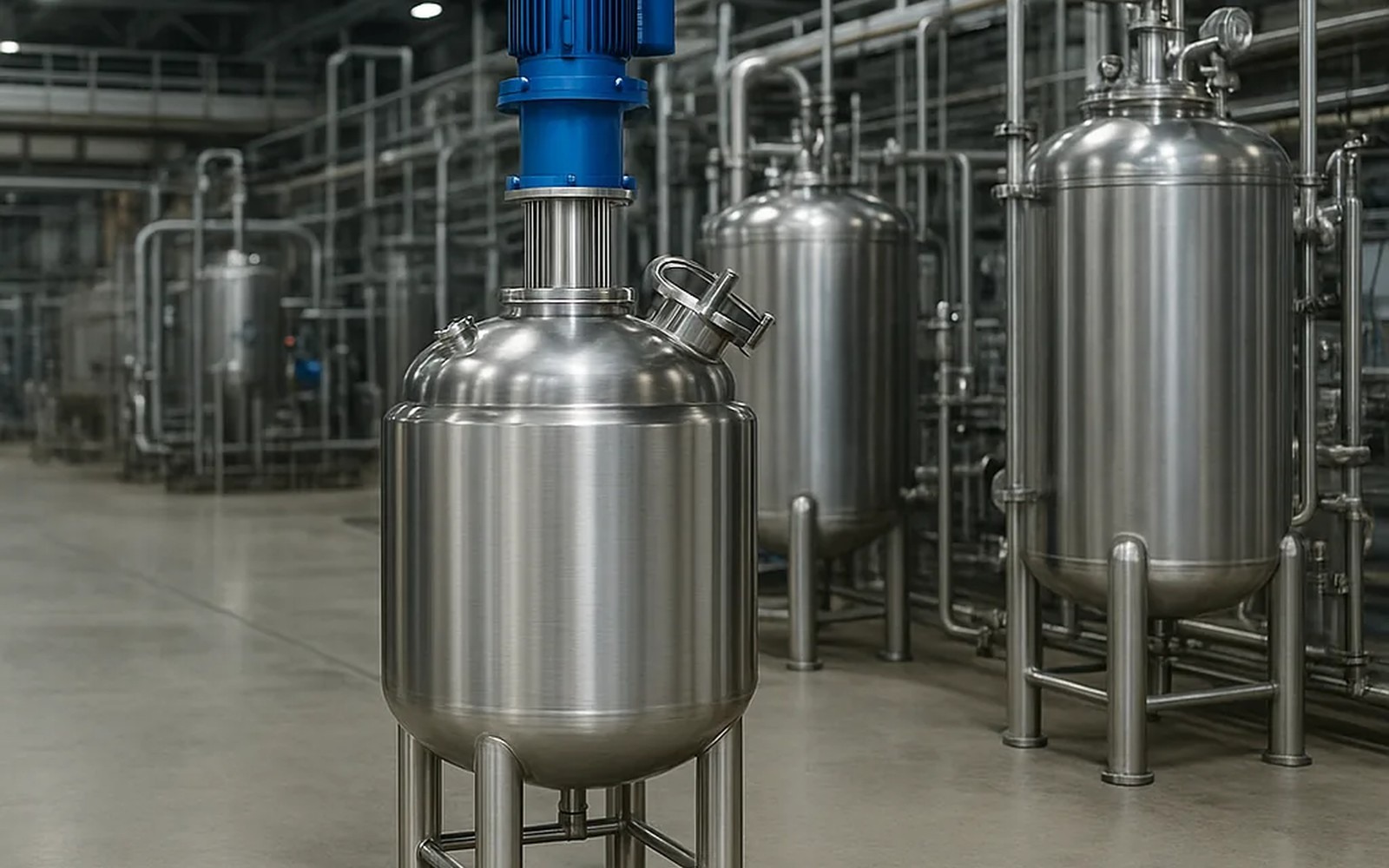
Mixing and Blending Tank
Finance a sanitary mixing or blending tank for juice, beverage, or functional drink production. New and used, challenged credit reviewed, with juice-line files kept short near $400k.
Every multi-ingredient beverage starts in a tank. Your flavor blend, your vitamin premix, your proprietary botanical formula, your sweetener solution: each ingredient has to meet every other ingredient at the right temperature, in the right order, with the right agitation before the product is ready to send to the filler. A mixing and blending tank is not a passive storage vessel. It is the piece of equipment where your formulation becomes your product, and getting the spec right on the tank directly affects consistency, batch-to-batch repeatability, and the speed at which you can turn around a production run.
We finance mixing and blending tanks for juice brands, functional beverage startups, kombucha producers, and beverage manufacturers who are scaling from hand-batching or pilot-scale mixing to commercial tank systems. Single sanitary stainless steel blending tanks in the 100 to 1,000 gallon range for commercial production typically price from $15,000 to $80,000 for basic configurations, and multi-tank systems with agitators, heating/cooling jackets, and CIP spray balls step well above that. Our financing starts at $50,000, which typically means a single well-specified production tank or a multi-tank blending station.
What Separates a Production Blending Tank from Basic Storage
A sanitary blending tank for beverage production is built to a different standard than a generic storage vessel. Key features matter: the agitator design (top-mount, side-mount, or bottom-entry) determines how efficiently ingredients mix without introducing air; the surface finish (typically 150 to 320 grit mechanically polished or electropolished interior) affects cleanability and prevents microbial harborage; the presence of a heating or cooling jacket allows you to hold the batch at a target temperature during mixing, which matters for ingredients that are temperature-sensitive or need to be dissolved at heat.
For juice brands working with high-pulp ingredients or viscous concentrates, the agitator geometry matters particularly. A low-shear mixing paddle maintains particulate integrity for a pulpy texture; a high-shear mixer breaks ingredients down aggressively for a smooth, homogenous product. Choosing the wrong agitator design for your product is a costly mistake that affects both quality and cleanability. CIP spray balls built into the tank head allow the tank to be cleaned in place without manual disassembly, which is critical if you are cleaning between flavors or products in the same vessel.
Many brands run a blending tank directly upstream of their bottle filling machine or canning line. The tank is a buffer that holds the blended batch while the filler draws from it at the line's fill rate. Matching the tank capacity to the filler's throughput and your batch size avoids starving the filler or holding finished product at the wrong temperature between batches.
Financing Your Blending Tank
Single tanks at the entry end of our range ($50,000 to $100,000) typically go through our application-only process: basic business information, three months of bank statements, and an equipment invoice or quote. Decisions come back within two to three business days in most cases. Multi-tank blending systems or tank installations that include CIP stations, transfer pumps, and ancillary plumbing can reach $200,000 to $600,000 or more, and those go through a standard credit review that requires financial statements and tax returns.
We finance blending tanks as standalone equipment or as part of a broader line project. If you are installing a complete production area that includes a tank farm, a homogenizer, and a filling line, bundling all of that into one transaction is often the cleanest approach. You get one set of terms and one monthly payment instead of multiple overlapping loans with staggered payoff dates.
Used blending tanks from reputable manufacturers like Cherry-Burrell, Feldmeier, or DCI Equipment hold their value well and can be financed the same as new. Many brands find solid used sanitary tanks through equipment dealers or when food and beverage facilities close or modernize. We finance used equipment without age restrictions as long as the collateral value is documented.
Related Equipment Worth Financing at the Same Time
A blending tank rarely stands alone in a production environment. The pieces that typically get financed alongside it include a jacketed batch tank if you need precise temperature control during mixing, a CIP system to clean the tank and associated piping in place, and transfer pumps that move product between vessels without introducing contamination. Each of these is financeable individually or as part of the same package.
If your product requires carbonation after blending, a carbonation system downstream of the blending tank is also a natural add to the financing package. And if you are building out refrigerated storage to hold batched product before filling, a walk-in cooler round out the production area. We finance all of these, and bundling related equipment into a single deal is something we do regularly for brands building out production capacity in stages.
Get Blending Tank Financing
Send us your tank specification, your batch size target, and whether you are buying from a dealer or a custom fabricator. We will structure the financing and respond within 24 hours. If you are building out a blending station with multiple tanks and supporting equipment, we want to see the full picture so we can put together one clean transaction. Your production consistency starts in that tank, and the financing should not slow down getting it into your facility.
Related Financing Paths
Common Questions on Mixing and Blending Tank
Straight answers before you send the equipment file.
Can I finance a custom-fabricated blending tank rather than an off-the-shelf unit?
Yes. Custom sanitary tanks from fabricators like Feldmeier or DCI are financed routinely. We need a fabrication quote or purchase order that documents the cost and specifications. The fabrication contract serves as the collateral documentation.
My blending tank is part of a larger production build-out. Can I finance the whole project?
Yes. We regularly finance complete production areas that include tanks, pumps, CIP systems, and filling equipment under a single package. You get one payment and one payoff date rather than managing multiple loans.
Can I finance blending tanks for a shared kitchen or co-manufacturing setup where the tanks serve multiple clients?
Co-packers and shared-production facilities qualify for financing. The key is that the business entity applying for financing is the owner of the equipment. The fact that the tanks are used to serve multiple client accounts does not affect the financing structure.
What if I need to upgrade my agitator on an existing tank? Can that be financed?
An agitator upgrade on its own is usually too small for our $50,000 minimum unless combined with other equipment. If you are upgrading multiple items in a tank area simultaneously, bundling them to meet the minimum threshold is worth discussing.
Are stainless steel sanitary tanks eligible for Section 179 deduction?
Sanitary production tanks classified as depreciable business equipment are generally eligible for Section 179 in the year they are placed in service. An equipment loan (ownership from day one) is typically required rather than a lease to qualify. Confirm with your tax advisor for your specific situation.
Ready to Finance Mixing and Blending Tank?
Send the equipment quote, seller, transaction size, and target timing. The financing desk will review the package and return a clear next step.