

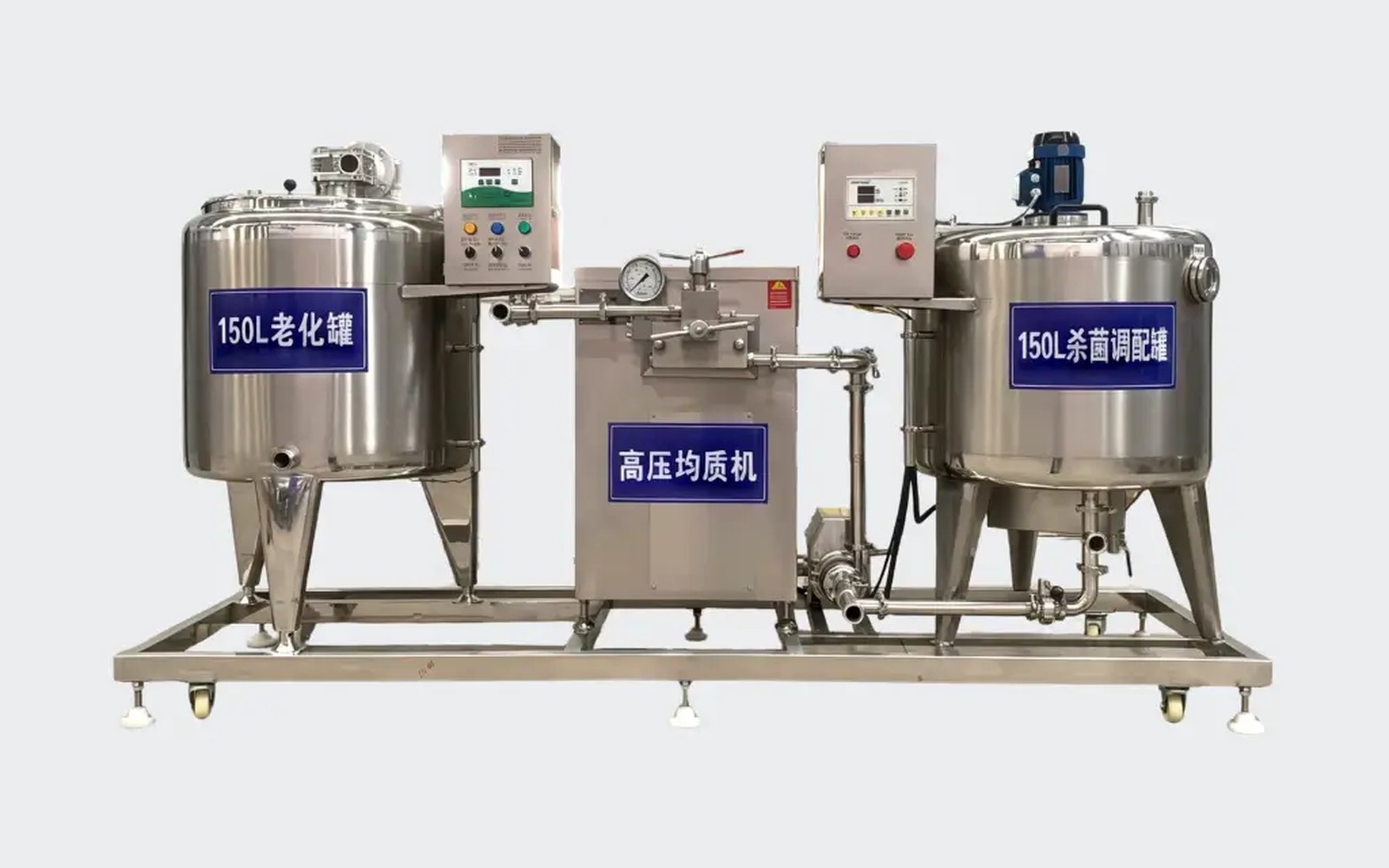
Homogenizer
Finance a high-pressure homogenizer for juice, plant milk, or beverage production. challenged credit reviewed, with juice-line files kept short near $400k, fast turnaround.
Emulsion stability is a shelf-life problem. A juice or plant-based beverage that separates in the bottle before it reaches the consumer's table does not earn repeat purchases, and a product that separates on the shelf earns a markdown. Homogenization solves the separation problem by forcing the liquid through a precision valve at high pressure, breaking fat globules and particulates into uniformly small droplets that remain suspended. The result is a product with consistent texture, extended stability, and the smooth mouthfeel that consumers expect from premium beverages.
We finance homogenizers for juice manufacturers, dairy and plant-milk producers, and functional beverage brands that are moving from bench-scale formulation to commercial production. High-pressure homogenizers from manufacturers like GEA, SPX FLOW, and Alfa Laval serve the beverage industry at a wide range of throughputs. Pilot-scale units suited to product development and small-batch production can price from $50,000 to $150,000. Full commercial units capable of tens of thousands of liters per hour are significantly more capital-intensive, and we finance both ends of that range.
How Homogenization Works in Beverage Production
A high-pressure homogenizer pumps liquid through a homogenizing valve at pressures typically ranging from 1,000 to 15,000 psi (about 70 to 1,000 bar) depending on the application. The sudden pressure drop as the product passes through the valve gap creates intense turbulence, shear forces, and cavitation that break particles down to a consistent, fine size distribution. The product exits at a higher temperature due to the energy input, which is why homogenization often integrates with an upstream or downstream heat-treatment step.
For juice, homogenization reduces pulp and fiber particles to a stable suspension, improves color consistency, and creates the uniform viscosity consumers associate with quality single-serve beverages. For plant-based milks (oat, almond, pea protein), homogenization is essential to achieve the stable emulsion that makes the product look and pour like dairy milk. Many commercial plant-milk operations require two-stage homogenization, where the first stage does the primary particle reduction and the second stage breaks up any reagglomerated clusters.
Homogenizers pair closely with pasteurizers. In many juice and milk lines, the product flows from the homogenizer directly into the pasteurizer or HTST system, or vice versa. Financing these as a combined project is common, and we can structure one package for both pieces of equipment if that is how you are building the line. A HTST pasteurization system and a homogenizer are often quoted together by equipment suppliers and should be financed together as well.
Homogenizer Buyers in the Beverage Industry
The two most common buyer types we see for homogenizer financing are production-scale manufacturers adding emulsion stability to an existing line, and startups building their first commercial plant and needing the whole system in place at once. The startup scenario is particularly interesting from a capital-planning standpoint because the homogenizer is often not the most expensive piece on the line but it is critical to product quality, so it has to be in the plan and the financing from day one.
Juice manufacturers moving into shelf-stable or ambient products rather than purely refrigerated need particularly tight control over homogenization because pasteurized ambient juice is far less forgiving of stability variation than a refrigerated product with a short shelf life. Getting the homogenizer spec right for ambient distribution is a real engineering decision, and having the capital to spec the right machine rather than the one that fits the immediate budget often makes a difference downstream.
Functional beverage startups, especially those formulating with protein fortification, botanical extracts, or oil-based ingredients, frequently encounter homogenization needs before they expect them. A beverage that is stable in a $5,000 lab homogenizer may behave differently when scaled to commercial throughput, and having financing in place for a commercial unit removes the delay between solving the formulation problem and getting back into production.
Financing a Homogenizer
Pilot-scale laboratory homogenizers below $50,000 fall under our financing minimum. Commercial production units typically fall in the $80,000 to $500,000+ range depending on throughput capacity and whether two-stage processing is required. For single homogenizer purchases up to $400,000, our application-only program requires three months of bank statements and basic business information, no tax returns needed. Larger multi-machine projects require a full credit package but still move through underwriting on a reasonable timeline.
We offer both equipment loans and equipment leases on homogenizers. Loans mean you own the asset outright from day one, which can be relevant if you plan to claim Section 179 depreciation or bonus depreciation in the tax year of purchase. Leases give you lower monthly payments and the ability to upgrade to a higher-throughput model when your volume grows. Both structures work for this equipment category, and we can discuss which fits your situation better when you submit your quote.
Start Your Homogenizer Financing
Give us the throughput target, the supplier or vendor quote, and whether you are bundling it with other line equipment. We will structure the financing and get back to you within 24 hours. The right homogenizer is the difference between a product that looks premium and one that separates on the shelf, and we want to make sure the capital is not the thing that slows that decision down.
Related Financing Paths
Common Questions on Homogenizer
Straight answers before you send the equipment file.
Can I finance a homogenizer together with a pasteurizer in the same deal?
Yes. Bundling related equipment into a single financing package is common and straightforward. We treat the combined system as one collateral package, which simplifies documentation and gives you one payment rather than two separate loans.
Are used homogenizers financeable?
Yes. Used homogenizers from established manufacturers hold their value well because the core components are durable and parts are available. We finance used equipment with documentation of the value, whether that is a dealer invoice or an independent appraisal.
My product is a plant-based milk. Is homogenizer financing different for non-juice applications?
No. The equipment financing is the same regardless of whether you are running juice, plant milk, or a functional beverage through the homogenizer. We finance the equipment based on its value and your business profile, not the specific product it processes.
Can I use Section 179 to deduct a financed homogenizer?
A financed piece of equipment purchased with an equipment loan is generally eligible for Section 179 deduction in the year of purchase, just as if you had paid cash. Talk to your CPA for your specific situation. We can also connect you with information on Section 179 financing structures.
What if the homogenizer I need is only $60,000? Is that too small?
No. Our minimum is $50,000, so a $60,000 homogenizer qualifies. The application-only process is especially streamlined at that size, requiring just your business basics and bank statements to move forward.
Ready to Finance Homogenizer?
Send the equipment quote, seller, transaction size, and target timing. The financing desk will review the package and return a clear next step.