

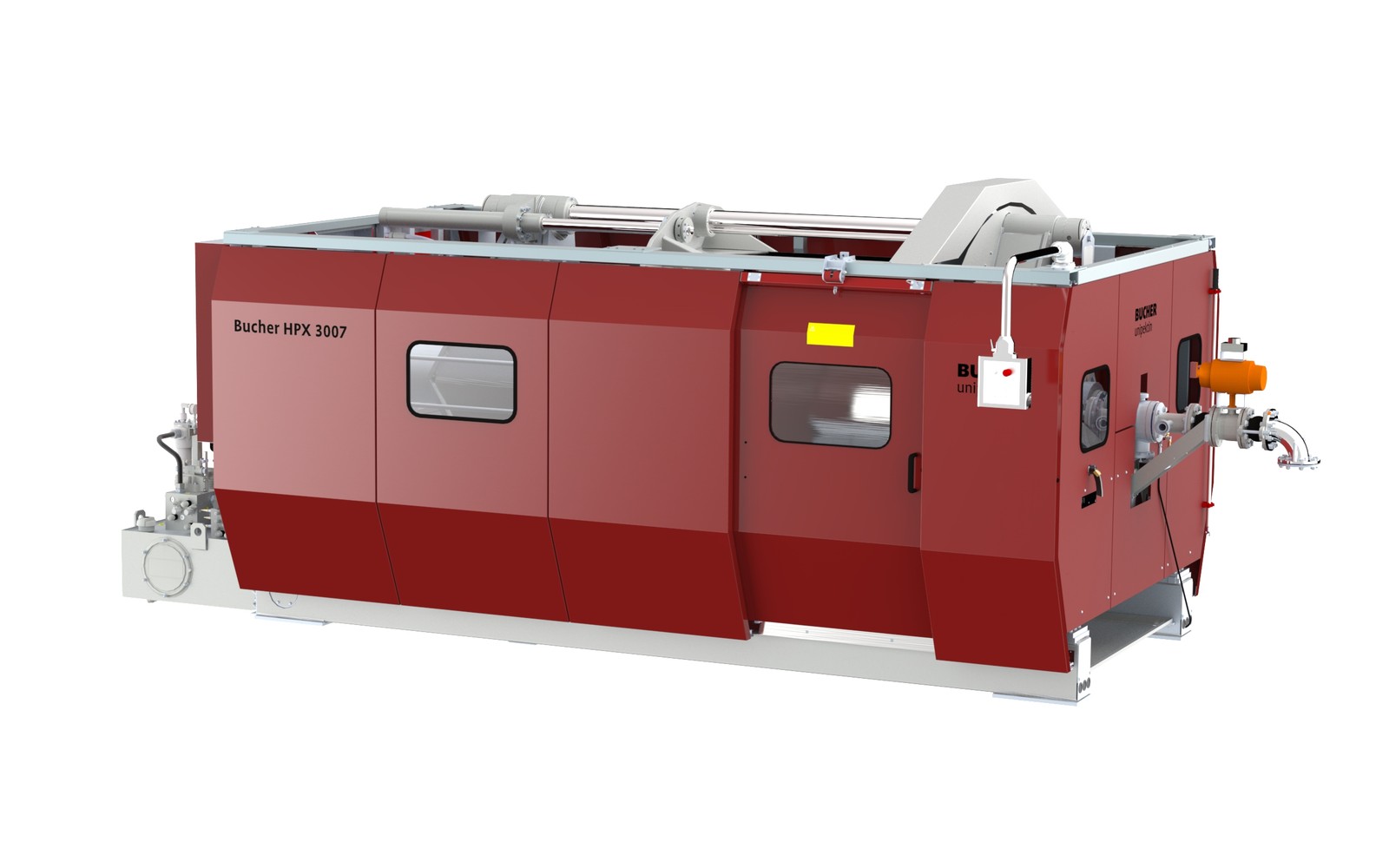
Bucher HPX 7507 Press Financing
Finance a Bucher HPX 7507 press with equipment loans and leases. $50k minimum, challenged credit reviewed, with juice-line files kept short near $400k, funded in 1-2 weeks.
Scale changes the press conversation entirely. A juice brand at the batch-run stage thinks about extraction quality per pressing bag; a brand running production at commercial scale thinks about liters per hour and the cost per unit of extracted volume. The Bucher HPX 7507 is a machine built for the second conversation. Bucher Unipektin, the Swiss-based food processing equipment manufacturer, designed the HPX series for industrial fruit and vegetable pressing, and the 7507 is one of the larger units in that lineup, intended for juice manufacturers, wineries, and cider producers who need high throughput and low residual moisture in the press cake.
For a juice manufacturer or large-scale beverage operation bringing this kind of production asset in-house, financing the Bucher HPX 7507 is a major transaction. These machines operate at a price point where deal structure, lender selection, and documentation preparation matter. We work with buyers on Bucher Unipektin equipment across the HPX product line, and lenders familiar with industrial food processing equipment recognize the brand as a serious, long-service-life asset with real secondary market presence.
HPX 7507 Design and Industrial Application
The Bucher HPX series uses a membrane press design. In this system, a flexible membrane inside the press drum expands under pneumatic pressure, pressing the fruit mash against a drain screen that allows juice to escape while retaining pomace. The pressing cycle can be controlled to run multiple pressure stages, allowing operators to balance extraction yield against pressing time and pomace dryness.
The 7507 designation reflects the machine's pressing volume capacity. At this size, the HPX 7507 is suited for operations processing significant tonnage of fruit per day: apple juice producers serving retail channels, citrus processors, and manufacturers making juice concentrate for food ingredient supply. The machine also serves grape pressing for winery operations and pear pressing for cider producers, though juice manufacturers are the primary buyer in the context we typically finance.
What distinguishes the HPX series in industrial juice production is the combination of high yield with a relatively dry press cake. Lower residual moisture in the pomace reduces waste handling costs and, in operations that sell or process the pomace as a byproduct (animal feed, compost, dried fiber), affects the quality of that secondary stream. These are operational details that matter at scale but rarely come up in smaller cold-press juicer discussions.
The industrial juice extractor category covers the broader set of machines at this scale, and the HPX 7507 occupies the high end of that category for press-based extraction. Operators evaluating between a press-based system like the Bucher HPX and an in-line extractor like a JBT unit are really making a product quality and process architecture choice: the Bucher press is the preferred tool when pomace dryness, gentle pressing, and batch flexibility matter more than speed.
Deal Structure for an HPX 7507 Transaction
The Bucher HPX 7507 is a large-ticket transaction. At this price range, lenders expect a complete package: three months of business bank statements, a summary of business financials, a description of the production operation, and for newer operations, a revenue and production plan. Application-only processing is available for well-qualified buyers on deals that fall under our threshold, but most 7507 transactions involve some degree of financial documentation.
Equipment loans and capital leases with terms of 48 to 84 months are the most common structures for industrial processing equipment in this category. A longer term reduces the monthly payment and is often appropriate when the machine is expected to run for many years in production, as Bucher press equipment typically does when maintained properly. An FMV lease structure may also make sense for buyers who want lower payments and optionality on the machine at end of term.
For established juice manufacturers, a strong bank statement history with consistent revenue, combined with a clear picture of how the 7507 fits into the production plan, is the foundation of a competitive deal. We present your file to multiple lenders and let the offers compete. For buyers whose credit profile has some complexity, we have lenders who specialize in industrial food production equipment and approach those files with relevant experience.
If you are also financing downstream equipment like a juice production line or packaging assets, a combined financing package on all the equipment together is typically more efficient than multiple separate notes. We structure these multi-asset deals regularly for manufacturers building out or expanding a juice production facility.
Where the HPX 7507 Fits in the Juice Market
The juice industry has consolidated significantly at the production level, and the middle tier of regional manufacturers who own their own pressing equipment occupies an interesting position. These are operations large enough to have moved beyond co-packing arrangements but not so large that they are running full plant-scale operations around the clock. The HPX 7507 is often the machine that enables that move: it gives a brand production control over its primary extraction step without requiring the full plant investment that the largest food processing lines demand.
Cold-press and premium juice brands that have established retail distribution are prime candidates for the HPX 7507 step-up. At a certain production volume, the economics of co-packing (paying for access to a press by the batch or by the unit) shift in favor of owning the extraction capacity outright. The press becomes an asset that generates margin per liter rather than a cost center. For cold-press juice brands at that inflection point, the HPX 7507 is a machine worth modeling carefully.
Bucher Unipektin also has a global service and parts network, which is a practical consideration for production equipment that needs to run reliably on a production schedule. Downtime on an HPX 7507 at a manufacturer's facility is not a theoretical cost; it is measured in lost production volume and supply chain disruption. Lenders familiar with the brand understand that the service infrastructure supports long-term machine reliability, which supports the collateral case for longer-term loan structures.
Start Your HPX 7507 Application
The 7507 is a major investment that deserves a lender who understands industrial juice processing equipment. Send us your application and production overview, and we will bring back competitive options from lenders who know this category.
Related Financing Paths
Common Questions on Bucher HPX 7507 Press Financing
Straight answers before you send the equipment file.
The HPX 7507 requires a foundation and installation work. Can those costs be rolled into the financing?
Site preparation and installation costs can sometimes be included in the financed amount when they are invoiced by the equipment vendor or a contractor working as part of the overall project. Soft costs that are billed separately from the machine invoice are harder to include but not impossible, depending on the lender. Provide us with the full scope of the project early, including all invoices, and we will tell you what is financeable and what is not.
I already own a Bucher HPX press that I paid cash for. Can I pull working capital out of it?
Yes. A sale-leaseback converts the equity in the machine to cash while you continue operating it on your production schedule. The sale-leaseback is structured by selling the machine to a financing company and immediately leasing it back, typically on a 36- to 60-month term. The cash proceeds can fund raw material purchasing, additional staffing, or any other operating need. See our cash-out refinance and sale-leaseback options for how we structure these transactions.
Does the HPX 7507 have a secondary market? I want to know what the collateral looks like to a lender.
Bucher press equipment does have a secondary market, particularly among wineries, cider producers, and juice manufacturers looking for used production capacity. The HPX series in good condition trades at prices that provide real collateral comfort. The secondary market is smaller than for more common food processing equipment categories, but the buyers who need these machines are willing to pay for them, and lenders familiar with the category understand that.
My operation is a co-packer moving toward owning our own pressing capacity. Is that a story that lenders understand?
Yes, and it is a story we help buyers tell clearly. A co-packer transitioning to in-house production is bringing a cost structure change that typically improves margin per unit as volume scales. We help you frame the production economics in a way that resonates with lenders: current co-pack cost per liter, projected in-house cost per liter at operating volume, and the volume level at which the machine pays for itself. That narrative, backed by bank statements showing existing revenue, makes for a compelling file.
Can I finance a used HPX 7507 purchased from a winery or apple juice producer?
Yes, used Bucher HPX units are financeable. The machine type and condition drive the valuation, and we may ask for photos or an inspection report on a used unit at this price point. Private-party purchases and broker-sourced machines both go through the same program. Provide us with the seller's invoice and a description of the machine's condition and service history, and we will tell you what we can do. For details on how private-party purchases work in our program, see our private-party equipment purchase page.
Ready to Finance Bucher HPX 7507 Press Financing?
Send the equipment quote, seller, transaction size, and target timing. The financing desk will review the package and return a clear next step.